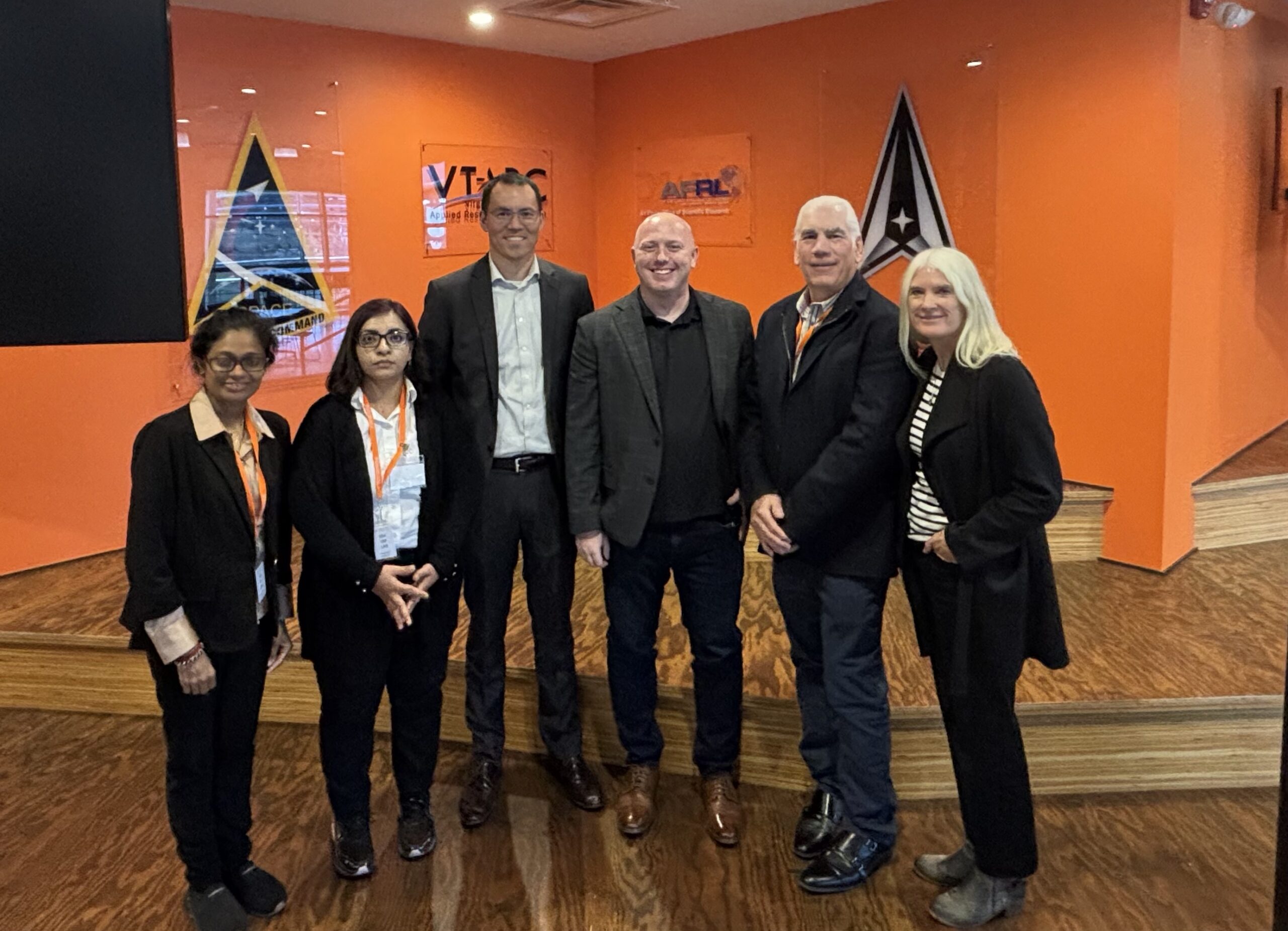

The BMC3I TAP Lab accelerates the delivery of space battle management solutions to defense centers by connecting commercial software companies with the testing, compliance support, and environment integration they need to succeed.
Through a structured cohort program, beginning with an Ask Me Anything webinar and Catalyst Wine Mixer and progressing into a six-week Stage 1 cohort experience, selected companies gain direct access to government and industry subject matter experts, customer discovery opportunities, and a growing network of partners working to strengthen the defense industrial base.
The result is a faster, lower-risk path for small businesses to deliver real capability to the warfighter.
Cohort 3 ran October 28–November 14, 2025, hosting three companies working across the following problem sets:
SDA TAP Lab Problem 1: Using commercial or public imagery, detect the start of a space launch cycle automatically.
SDA TAP Lab Problem 3: Using seismic data, commercially available cell-phone accelerometer data, or weather data, detect the time and location of foreign space launches automatically.
SDA TAP Lab Problem 7: Using orbital data and/or knowledge of sensors and satellites, develop a sensor search technique that maximizes the probability of reacquiring a satellite or space launch vehicle. The technique must be valid for ground or space based EO, IR, RF, or RADAR sensors.
SDA TAP Lab Problem 9: Using orbital data, develop a specialized technique to process uncorrelated tracks (UCTs) and promote candidate orbits generated from UCTs which may actively manage their optical or radar signatures or otherwise be evading detection, tracking, and identification.
SDA TAP Lab Problem 11: Using orbital data, automatically detect separation events and classify them as either 1) sub-satellite deployment, 2) Debris generating event. Further sub-classify debris generating events, as either: Shedding, Explosion, Impact
SDA TAP Lab Problem 16: Since we assume surprise may come through camouflage, concealment, deception or maneuver (CCDM) we must interrogate targets for evidence of CCDM. Develop techniques to evaluate whether combinations of the following are true of UCT candidate orbits, or satellites in a catalog classified as unknown (UNK), debris (DEB), rocket body (R/B), or an inactive payload:
SDA TAP Lab Problem 20: Generate a radio frequency (RF) pattern of life for individual satellites. This may include typical bandwidth, channel, mode, center frequency, power, encryption, or beam pointing.
| October 28-31, 2025 | Kickoff and Virtual Programming | |
| November 4-14, 2025 | In-Person Programming | |
| November 17-December 5, 2025 | Virtual Programming |

At DeployHub, we believe every live production environment deserves software that can defend itself the moment new threats emerge. DeployHub is building a future where security and speed go hand in hand, where open-source innovation doesn’t mean added risk. Our customers trust us to continuously protect live software with AIdriven digital twins, cutting remediation from months to days and ensuring systems stay resilient from cloud to edge.

Soresu advances applied AI for defense by turning distributed systems into living networks that learn, adapt, and persist under pressure. Our flagship technology, SWIFT-A, orchestrates space, air, and ground sensors to maintain custody and detect events autonomously, even in degraded environments. We move fast, take smart risks, and bring commercial-grade AI to the most demanding missions on Earth and in orbit. By decentralizing inference and decision-making, SWIFT-A transforms disconnected sensors into a self-organizing swarm that keeps awareness alive when the network goes dark.

UtopiaCompression empowers mission success by delivering advanced capabilities that elevate situational awareness, accelerate decision-making, and strengthen operational effectiveness across defense and commercial domains.